For the indie maker or prompt-first creator, the initial thrill of generating a high-quality image often masks a looming operational challenge: consistency. Producing one “hero” image for a landing page is relatively straightforward with current models, but scaling that single aesthetic into a full-scale marketing campaign—encompassing display ads, social media carousels, and email headers—requires a shift from creative exploration to production management.
The current landscape of generative tools often prioritizes the “one-off” masterpiece. However, when building a brand identity or launching a product, the priority shifts to visual continuity. This is where the workflow within Nano Banana Pro begins to show its value, moving away from the “slot machine” approach to a more deterministic, operator-led process.
The Shift from Image Generation to Asset Production
Indie makers frequently fall into the trap of spending hours refining a single prompt to get the “perfect” look, only to realize that the result cannot be easily replicated for a secondary asset. If your landing page features a specific 3D-rendered character or a particular grit-heavy editorial style, you need that same character or style to appear in a 1080×1920 Instagram Story and a 1200×628 LinkedIn ad.
Using a platform like Banana Pro allows creators to move beyond the prompt box and into a “Canvas” environment. The distinction here is critical. A standard chat interface treats every request as a new beginning. A canvas-based workflow treats your assets as a persistent project. By utilizing Nano Banana Pro, creators can maintain a visual anchor, ensuring that subsequent generations share the same latent DNA as the original hero asset.
Building the Landing Page Foundation
The hero section of a landing page is usually the first place a creator deploys generative AI. It is the high-stakes visual that sets the tone for the entire conversion funnel. When using Nano Banana, the goal is often to create a clean, high-fidelity background or a centerpiece that communicates the product’s value proposition without being distracting.
However, a common limitation at this stage is the “hallucination” of specific UI elements or text. While Nano Banana Pro has made significant strides in rendering coherent shapes, it is still uncertain whether complex, nested data visualizations or specific brand typography will render correctly on the first pass. Operators should expect to use the AI Image Editor to clean up artifacts or leave “dead space” where actual CSS-rendered text will live.
Practical judgment suggests that the AI should handle the atmospheric and textural work, while the precise messaging remains a manual design task. Relying entirely on generative output for text-heavy assets usually results in a “cheap” AI-feel that can hurt conversion rates.
Scaling for Ad Creative: The Variation Logic
Once the landing page aesthetic is locked in, the marketer’s focus shifts to volume. Performance marketing thrives on testing. You don’t just need one ad; you need ten variations to see which color palette, composition, or subject matter resonates with the target audience.
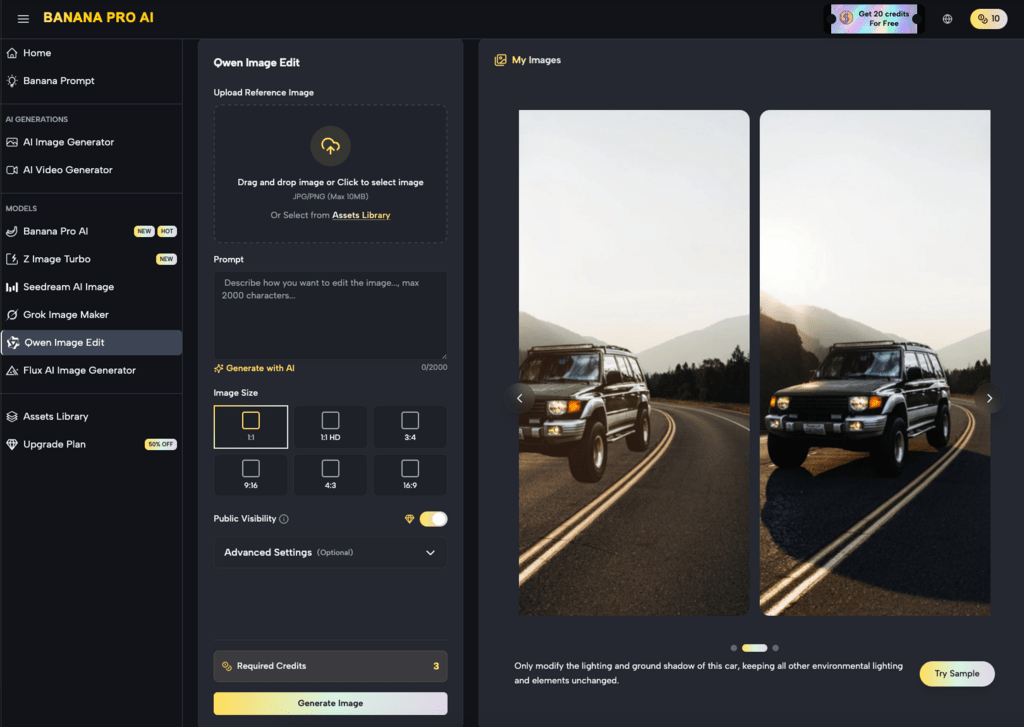
This is where the Nano Banana Pro environment becomes an operational lever. Instead of rewriting prompts from scratch, creators can use the image-to-image capabilities to maintain the core composition while swapping out peripheral elements.
For example, if you are running a campaign for a productivity app:
- The Anchor: A high-contrast, minimalist desk setup generated via Nano Banana.
- Variation A: The same setup but with a “night mode” color palette.
- Variation B: The same setup with a focus on a different device (e.g., tablet vs. laptop).
- Variation C: Adjusting the “mood” from professional to creative by injecting different background elements.
By keeping the seed or the reference image constant within the Banana AI workflow, the output remains recognizably part of the same campaign. This visual “scaffolding” prevents the jarring experience users have when an ad looks nothing like the page they eventually land on.
Social Media Integration and the Aspect Ratio Challenge
Social media requires a diverse range of formats. A square post for the grid, a vertical video for Reels, and a horizontal banner for Twitter/X. Standard generative tools often struggle with “outpainting” or expanding a composition without losing the original’s integrity.
In a production workflow, Nano Banana Pro allows for more controlled expansion. When a creator needs to turn a 1:1 image into a 9:16 Story, the process isn’t just about stretching pixels. It’s about intelligently filling the frame with contextually relevant content.
However, it is important to reset expectations here: AI-driven outpainting is not a “set it and forget it” feature. There is a persistent uncertainty regarding how the model will interpret the edges of a frame. Sometimes it creates repetitive patterns; other times, it introduces unwanted artifacts. The role of the operator is to guide the AI Image Editor through multiple iterations, masking out the “errors” and re-generating specific zones until the extension feels seamless.
The Role of Nano Banana in Rapid Iteration
For many indie makers, speed is the only real competitive advantage against larger teams. Nano Banana Pro is optimized for this “speed-to-market” mindset. Because the models are tuned for efficiency, the feedback loop between a prompt and a usable asset is shortened.
This efficiency allows for a “fail fast” approach to creative. If a particular visual direction isn’t working during the initial drafting of a social media campaign, the cost of pivoting is near zero. You aren’t waiting twenty minutes for a render; you are seeing results in seconds. This allows the creator to spend more time on the strategy of the campaign rather than the mechanics of the tool.
Managing Visual Continuity with Nano Banana Pro
The most advanced use case for Nano Banana Pro involves creating a custom “style guide” within the tool. While the platform provides a range of pre-set models, the real power lies in understanding how to “weight” your prompts to ensure consistency.
If you find a specific combination of lighting and texture that works, you should document the specific parameters used in the Nano Banana Pro interface. Using the same “sampling method” and “CFG scale” across all assets in a campaign is just as important as using the same hex codes in traditional design. This technical discipline is what separates a professional-looking campaign from a collection of loosely related AI images.
Limitations: Where the Human Must Step In
Despite the power of tools like Nano Banana, there are areas where the technology still hits a ceiling.
- Anatomical and Spatial Logic: In complex scenes where multiple characters are interacting, Nano Banana Pro can occasionally struggle with limb placement or the physics of shadows. For “lifestyle” ads, these small errors can break the viewer’s immersion. Operators should always do a final “sanity check” at 100% zoom.
- Brand Specificity: AI currently lacks the ability to understand “brand soul.” It can replicate a style, but it cannot know that your brand avoids certain colors for psychological reasons or that your logo must always have a specific amount of clear space around it.
The AI Image Editor is a powerful tool for fixing these issues, but it requires a human eye trained in basic design principles. The “AI feel” that many marketers worry about often comes from a lack of human oversight rather than a failure of the model itself.
Optimizing the Workflow Studio for Team Collaboration
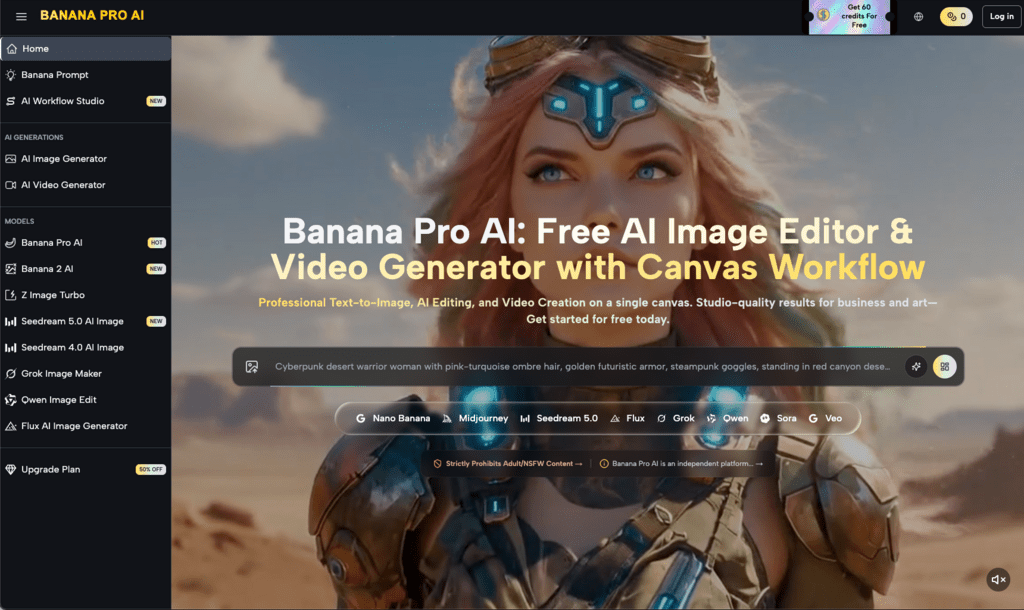
Even for indie makers, collaboration is often necessary—whether it’s with a freelance copywriter or a part-time VA. The “Workflow Studio” aspect of these tools allows for a more transparent creative process. Instead of passing around static PNGs, creators can share the logic behind the generation.
By standardizing the use of Banana Pro across a small team, everyone understands how to generate “on-brand” content. This reduces the friction of creative hand-offs. If the social media manager knows exactly which settings were used for the landing page hero, they can generate their own supporting assets without needing constant direction from the founder.
A Practical Checklist for Campaign Asset Scaling
To get the most out of a generative pipeline, creators should follow a structured approach:
- Phase 1: The Core Asset. Use Nano Banana to generate the highest-fidelity version of your creative concept. This is your “North Star.”
- Phase 2: The Variation Matrix. Take that core asset into the Canvas and generate 5–10 variations with slight modifications to color, lighting, or subject focal point.
- Phase 3: Format Expansion. Use the outpainting and resizing tools to adapt these variations for different social platforms.
- Phase 4: Refinement. Use the AI Image Editor to remove artifacts, fix lighting inconsistencies, and prepare the assets for final text overlays in a layout tool.
The Future of Prompt-First Creation
The transition from “prompting for fun” to “prompting for production” is the hallmark of the modern creator. Tools like Nano Banana Pro are bridging the gap between raw generative power and the controlled requirements of the marketing world.
While we are not yet at a point where a single click can generate a 360-degree marketing campaign, the tools are providing the “Lego blocks” necessary to build one faster than ever before. The key is to stop viewing the AI as a magic wand and start viewing it as a highly capable assistant that requires clear, operational boundaries.
In the end, the most successful campaigns won’t be the ones that use the “best” AI, but the ones that use AI to maintain the most consistent and compelling brand story across every touchpoint. By mastering the nuances of the Nano Banana Pro workflow, indie makers can finally compete with the visual output of much larger agencies, all while maintaining the agility that defines the creator economy.