
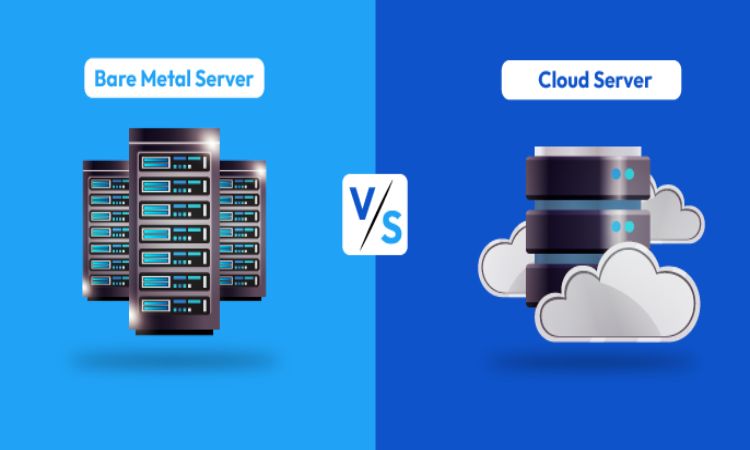
If you’ve spent any time looking at how companies are building AI in 2026, you’ve probably noticed that the conversation has shifted. A few years ago, the goal was just to “get some GPUs” and start experimenting. Today, the stakes are much higher. Whether you’re training a massive Large Language Model (LLM) or running real-time computer vision for a factory floor, the underlying infrastructure isn’t just a detail; it’s the entire engine.
When deciding how to build that engine, most businesses find themselves at a crossroads: Bare Metal or GPU cloud? Both are popular among AI cloud solutions providers, but they serve very different needs. To choose correctly, you have to think through exactly what your workload is trying to achieve.
The “Noisy Neighbor” Problem vs. Total Control
To understand Bare Metal, it helps to imagine having the keys to a high-performance sports car that nobody else is allowed to drive. A Bare Metal server is a dedicated physical machine. There is no virtualization layer—meaning no “hypervisor” sitting between your AI code and the actual silicon of the NVIDIA H100 or L40S GPUs.
In a standard cloud environment, you’re often sharing physical hardware with other “tenants”. Even if you don’t see them, their heavy traffic can sometimes cause “jitter” or unpredictable performance dips—often called the “noisy neighbour” effect. For AI workloads that require absolute consistency, like high-frequency financial modelling, Bare Metal is the gold standard.
Why GPU Cloud is the “Elastic” Choice
On the flip side, most GPU cloud providers offer a more flexible, virtualised approach. This is the “on-demand” model we’ve all come to love. If you need 50 GPUs for three hours to fine-tune a model and then want to turn them off to stop the billing clock, the cloud is your best friend.
A mild digression here: many people assume “cloud” always means “slower”, but in 2026, that gap has closed significantly. Platforms like Tata Communications’ Vayu AI Cloud use non-blocking InfiniBand networking, which allows GPUs to talk to each other almost as if they were on the same physical board. You get the agility of the cloud with performance that rivals a dedicated setup.
Matching the Infrastructure to the Task
So, how do you actually decide? It usually comes down to the specific phase of your AI’s lifecycle:
- Large-Scale Model Training: If you are building an LLM from scratch, you need raw, sustained power for weeks or months. Bare Metal is usually more cost-effective here because you aren’t paying the “convenience tax” of a virtualized environment, and you get 100% of the hardware’s capability.
- Inference and Real-Time Deployment: If your AI is already trained and is now just answering user queries, you need to scale up and down based on traffic. A GPU Cloud setup allows you to handle a spike in users at 2 PM and scale down to near-zero at 2 AM.
The 2026 Reality: Hybrid is King
The most interesting trend we’re seeing this year is that companies are no longer choosing just one. They are using a “Digital Fabric” approach. For example, a bank might keep their sensitive data and core model training on a Sovereign Bare Metal setup within their own borders to satisfy regulators, while using a GPU Cloud for their customer-facing mobile app features.
Tata Communications has leaned heavily into this “purpose-built” philosophy. Their Vayu AI Cloud isn’t just a list of specs; it’s an ecosystem. They provide the “Multi-Cloud Connect” that lets your Bare Metal servers in Mumbai talk to your edge devices in London as if they were in the same room.
Thinking Through the Costs
Naturally, the CFO is going to ask about the bottom line. It’s worth noting that Bare Metal often has a higher upfront “commitment” but a lower Total Cost of Ownership (TCO) for long-term, 24/7 workloads. Cloud-based solutions are usually better for experimental projects or bursting workloads where you don’t want to be locked into a contract.