Introduction
There is a common belief that the issue of data security just involves passwords, firewalls, and cyberattacks. Nevertheless, paper remains among the most convenient means of personal information being leaked. Employee records, medical documents, legal papers, old invoices, and customer files are all potential risks that could be destroyed if not properly destroyed.
This is the reason why paper shredding is still important. It does not simply involve desk duty. It belongs to the sphere of ensuring personal information is safe, protecting business data, and minimizing the possibility of avoidable errors. This is also where professional shredding services play a key role, offering a more secure and structured way to handle sensitive documents.
Whether a small office shredder suffices or it would be more intelligent to outsource it is the question that is not a secret. On the surface, this idea of paper-shredding internally sounds simple and inexpensive. But once you put into the equation security, time, compliance, and the day-to-day workflow, the answer is more complex.
Why Shredding Matters More Than People Realize
Paper records are usually filled with the same kind of information that should never be left out of view: name, address, account number, signature, health data, payroll data, and also inside business data. Even one carelessly discarded file can create trouble.
A major point that is often missed is that paper disposal is not only about stopping theft. It is also concerned with avoiding accidental exposure. An item found in an open trash bin, a half-shredded sheet wedged in a jammed machine, or a label left on a folder can tell a lot more than one had thought.
That is, bad shredding habits do not require criminal intent to be an issue. Occasionally the harm begins with mere negligence.
Why DIY Shredding Feels Like the Easy Choice
DIY shredding is appealing for obvious reasons. You buy a shredder, place it in the office, and feed documents into it when needed. This can be quite logical to freelancers, home offices, or small businesses that only have a few paper records.
It gives individuals a feeling of power. At your convenience, you will be able to shred your documents, not having to wait until a pickup appointment or outside service is made. The initial expense is also seeming quite manageable, particularly when compared to the cost of maintaining it.
A DIY shredder can be efficient enough in instances of low-volume, low-risk paperwork. A simple machine can be useful in case you are disposing of the occasional non-sensitive document.
However, that is no more than half the story.
The Hidden Downsides of DIY Shredding
The large issue with DIY shredding is that it often appears to be less expensive than it actually is.
A mini shredder can be cheap in the short run, but the actual cost is evident in the sluggish work processes, time spent by employees, maintenance, replacement of the machine, and the loss of security. To slice huge piles of paper, one needs to be focused and have patience. Someone has to remove staples, clear jams, empty bins, and deal with overheating.
In many workplaces, shredding becomes one of those “small tasks” that quietly drain time every week. No one notices the cost because it is spread across employees and hours. But over months, it adds up.
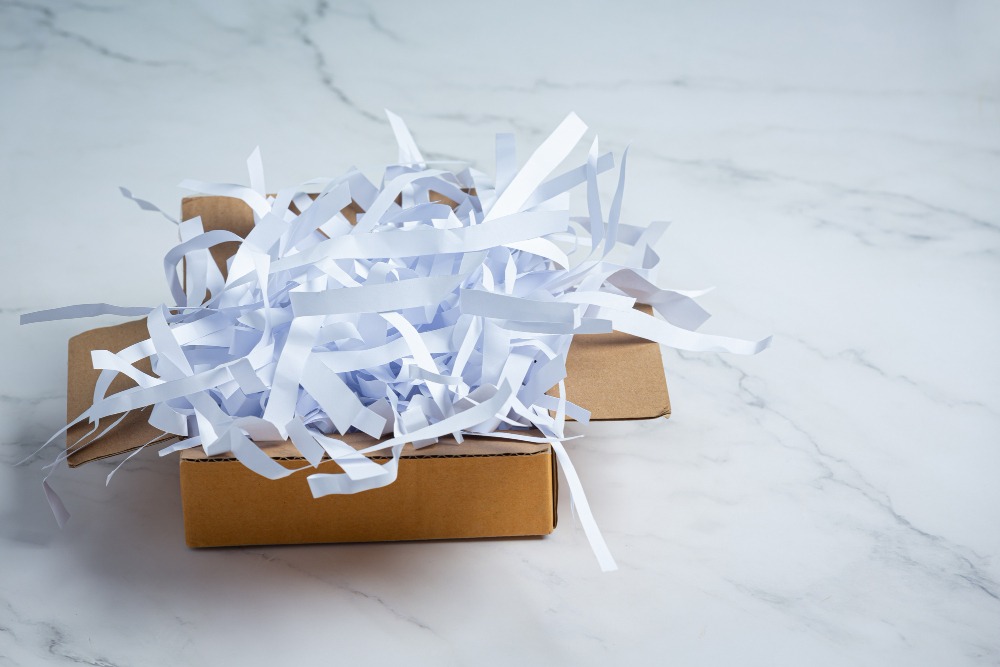
Security is another concern. Many office shredders use strip-cut or low-security cutting methods. They can do fine with junk mail, but not with confidential records. When documents include finances, legal, employee, or health-related information, lower-grade shredding might not be sufficient.
The typical mistakes that people make in in-house shredding are also the following:
- Disposing of shredded paper in the normal rubbish.
- The ability to forget shredding envelopes, labels, and sticky notes is a superpower.
- Letting full shred bins sit unattended
- Using old or poorly maintained machines
- Assuming all shredded paper is impossible to recover
These habits create weak points in what should be a secure process.
What Professional Shredding Services Do Better:
This is where professional shredding services stand out. They are meant to manage document destruction as a secure, documented process and not as an office-side job.
Professional shredders will have superior ratings to most personal shredders. They also offer chain-of-custody, secured handling, and certificates of destruction. This documentation is important to businesses that need to comply with regulations regarding privacy and disposition of records.
Flexibility is also another advantage. Other providers provide on-site shredding, whereby a truck delivers to your location and then shreds your documents there. Some provide off-site shredding, where the materials are transported to a facility in a secure manner. Both alternatives can be used to save time and stress internal teams.
Professional shredding is also more likely to assist recycling. Not only is that relevant to sustainability imperatives, but also to businesses that desire their disposal practices to be environmentally friendly.
The Overlooked Cost: Employee Focus
One unique way to think about shredding is this: every hour spent feeding paper into a machine is an hour not spent on customer service, sales, compliance, operations, or core business work.
This is often the real dividing line between DIY and outsourcing.
Businesses rarely struggle because shredding itself is difficult. They struggle because shredding interrupts more valuable work. A process that feels manageable in theory becomes frustrating in practice when paper stacks build up, and no one has time to deal with them.
Outsourcing document destruction is not just about convenience. It is often about protecting employee focus and keeping office energy directed toward work that actually grows or supports the business.
The Trust Factor Few Businesses Talk About
Another angle that deserves more attention is reputation.
Organizations are entrusted with personal information by people on a daily basis. Even after clients, patients, workers, and customers no longer need their records, they are under the assumption that they are going to be treated carefully. Bad disposal habits may destroy that trust within a short time.
The shredding operation is safe, and this is a good message: the safety of the information is taken into consideration at each phase, and it does not depend only on the time when the documents are in use but also on the time when they are destroyed.
This is especially important in those spheres such as healthcare, finance, legal services, education, and human resources, where the records often contain extremely personal data.
Which Option Is Right for You?
DIY shredding may be enough if you have a very small volume of non-sensitive papers and no major compliance demands. In that setting, a basic shredder can be practical.
However, when dealing with personal documents, when your company requires a record of shredding, or when you process a lot of paperwork on a daily basis, professional shredding tends to be the better option. It enhances safety, saves time, enables adherence, and minimizes the possibility of error.
Final Thoughts
Shredding should not be treated as an afterthought. It belongs to a broader document security strategy, and the correct approach cannot be considered only through the price.
DIY shredding is convenient for light usage, whereas professional services are structured and have stronger protection, as well as peace of mind. The most appropriate option in most instances is that which eliminates the risk before it becomes an issue.