Performance marketing has reached a point where media buying algorithms are significantly faster than the creative teams supporting them. A media buyer can identify a winning audience or a failing “hook” in a matter of hours, but the turnaround for a fresh set of variants often takes days or weeks. This friction is the primary bottleneck in scaling paid social campaigns. When the data says you need a lifestyle-oriented variation of a product shot by tomorrow morning, traditional production pipelines—involving studio time, prop sourcing, and manual retouching—simply cannot keep up.
The industry is moving toward a model where high-fidelity iteration replaces the slow conceptual phase. The goal is no longer just “generating images” but rather generating production-ready assets that require minimal post-processing. To do this effectively, creative teams are integrating specialized models designed for high-resolution output and spatial accuracy.
The High Cost of the Creative Bottleneck in Performance Marketing
The current mismatch between algorithmic efficiency and creative production creates a “latency tax.” While Meta or TikTok’s algorithms can cycle through creative variants to find the most efficient path to conversion, they require a constant feed of high-quality visuals to do so. When a creative team fails to provide enough diverse assets, the algorithm defaults to the few existing ones, leading to rapid creative fatigue and rising CPAs.
Historically, marketers tried to solve this with “low-fidelity” AI mockups. These were useful for brainstorming but often lacked the polish required for high-spend campaigns. Common issues included inconsistent lighting, warped product geometry, and low-resolution textures that looked “AI-generated” to the discerning eye of a consumer. A grainy or anatomically incorrect image doesn’t just fail to convert; it damages brand equity.
The strategic necessity today is the move beyond mockups. Marketing teams need tools that bridge the gap between a prompt and a final export. This means moving toward models that prioritize architectural integrity and high-resolution rendering from the start.
Accelerating the Flywheel: High-Fidelity Outputs with Nano Banana Pro
To solve the production lag, teams are turning to Nano Banana Pro to generate assets that are natively high-resolution. Unlike standard diffusion models that often struggle with spatial relationships—placing a product “on” a table rather than “in” the scene—this model handles complex spatial prompts with a higher degree of physical logic.
For a performance marketer, this level of precision is critical when building product-centric ads. If you are selling a luxury skin-care bottle, the way light refracts through the glass and the way shadows fall on the surface dictates the perceived value of the product. Nano Banana Pro AI provides the granular control over these environmental factors, allowing creators to iterate on “mood” or “setting” without losing the product’s structural integrity.
A significant part of the efficiency gain comes from the output resolution. Many tools output at standard 1024×1024, which limits the ability to crop for different platforms. When assets are rendered or upscaled to K-level resolution, a single horizontal generation can be intelligently cropped into a 9:16 vertical for Reels, a 4:5 for Instagram feeds, and a 1:1 for static carousels. This “generate once, deploy everywhere” approach significantly reduces the time designers spend on resizing and re-exporting. However, it is important to note that even with high-resolution upscaling, the AI may occasionally introduce “over-sharpened” textures that require a quick Gaussian blur or grain layer to feel truly organic.
Motion-Testing: Converting Static Success into Video Creative
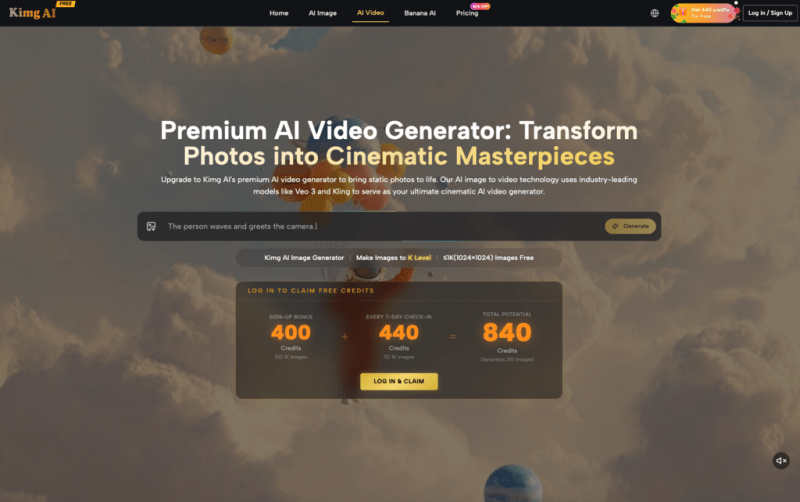
Once a static asset shows high performance in a test group, the logical next step is to convert that “winner” into a video. Short-form video platforms demand high-motion creatives, but producing 20 different video variations is traditionally cost-prohibitive. This is where the workflow within Kimg AI becomes a tactical advantage for small-to-mid-sized creative teams.
By using image-to-video tools, marketers can take the high-fidelity output from their initial generation and animate specific elements. This isn’t just about adding a Ken Burns effect; it’s about simulating camera paths, environmental motion like wind or water, and focal shifts.
The tactical goal here is optimizing for the “thumb-stop” rate in the first three seconds. By iterating on the motion speed—creating a fast-paced version for TikTok and a more cinematic, slower version for YouTube Shorts—teams can test which psychological pacing resonates with different demographics. This level of granularity in video testing was previously reserved for brands with massive production budgets.
One limitation to keep in mind: generative video physics are still not perfect. While a camera pan across a static product usually looks seamless, complex human movements or fluid dynamics (like pouring a drink) can still result in visual artifacts. High-performing teams use these tools for atmospheric and environmental motion rather than attempting complex character acting, which still requires human-led videography.

Critical Guardrails: Where Generative Iteration Faces Structural Limits
While the speed of Nano Banana Pro is transformative, a “hands-off” approach is a recipe for campaign failure. There are specific areas where generative engines currently face structural limitations, and ignoring these leads to the “uncanny valley” effect that triggers ad fatigue.
First, typography remains a challenge. Even with the latest text-rendering capabilities, brand-specific fonts and exact iconography are rarely perfect on the first try. Expecting an AI model to render a complex logo perfectly integrated into a scene is unrealistic. The most efficient workflow involves generating the background and product lighting via AI, then overlaying brand typography and logos in a standard design tool like Photoshop or Illustrator.
Second, anatomical and product accuracy requires strict human quality control. If a product has a specific number of buttons or a unique texture pattern, generative tools might hallucinate variations. It is unsafe to assume that out of 50 generated variants, all 50 will be “on-brand.” A designer’s role is now less about pushing pixels and more about being a curator who filters for these structural anomalies.
Finally, there is an uncertainty regarding how platforms will eventually tag and weight AI-generated content in their algorithms. While high-quality AI assets currently perform at or above the level of traditional photography in many A/B tests, the transparency requirements from major ad platforms are evolving. Maintaining a library of original “seed” images and using AI primarily for environmental and stylistic iteration is a safer long-term strategy than relying on 100% synthetic production.
Workflow Orchestration: Embedding AI Tools into Professional Design Stacks
The real ROI of integrating Nano Banana Pro into a creative stack isn’t just about “faster images”; it’s about shifting the designer’s role. In a traditional setup, a designer is a laborer. In an AI-augmented setup, the designer becomes a Creative Director of AI outputs.
The ideal workflow looks like this:
- The Brief: The media buyer identifies a need for “summer-themed lifestyle shots” for an outdoor gear brand.
- The Generation: The creative lead uses Nano Banana Pro to generate 50 high-fidelity variants across different lighting conditions (golden hour, midday sun, overcast).
- The Selection: The lead selects the 5 best performers and runs them through a K-level upscaler to ensure professional clarity.
- The Post-Production: A designer adds the specific product logo and promotional copy in a standard design suite.
- The Video Pivot: The winning static images are fed into the video generator to create 15-second atmospheric loops for social stories.
This feedback loop ensures that the creative team is working on the highest-leverage tasks—curation, branding, and strategic alignment—rather than manual cropping and lighting adjustments. By the time a campaign shows signs of performance decay, the next batch of variants is already rendered and ready for deployment.
Ultimately, the goal is to reduce the time-to-market. When you can move from a hypothesis (e.g., “Will a blue background convert better than green for this demographic?”) to a live ad in two hours, you aren’t just saving money on production; you are accelerating the rate at which your brand learns what actually moves the needle.