
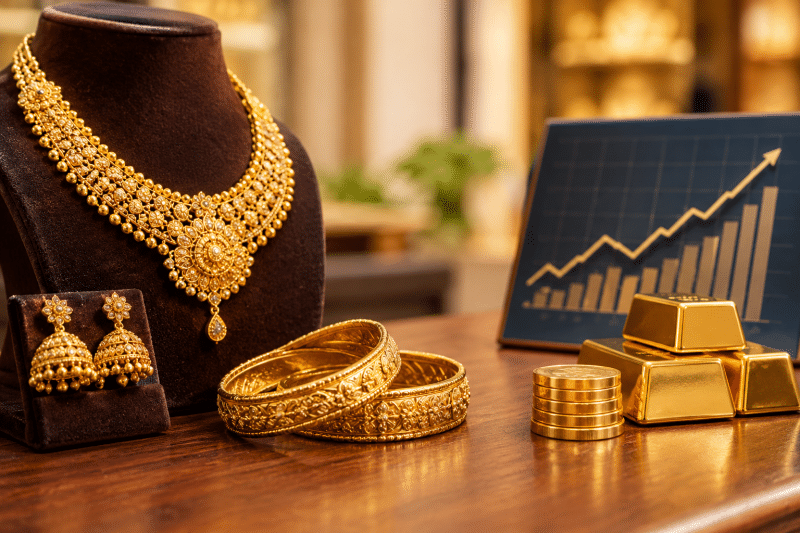
Gold Rate directly affects the prices of Gold jewellery as the metal forms the bulk of the final cost. If the market rate of gold changes, the value of the gold used in making a ring, chain, bangle or necklace also changes. The final bill is not just based on the rate of the metal. The amount paid can also vary with the purity, weight, making charges, stones and taxes.
The Gold Rate quoted in the market is generally for a particular purity and weight, for instance, for 24-carat gold for 10 grams. Pure gold is soft so jewellery is often made from 22 carat or 18 carat gold. Therefore the value of the metal in a piece of jewellery is calculated using the quoted market rate for the metal adjusted for purity.
How Gold Rate is Incorporated in Jewellery Prices
First, you have to determine the value of the gold used to create the item One easy method is to:
Gold value = applicable gold rate per gm x net gold weight
For example, if the current rate of 22-carat gold is ₹10,000 per gram and a chain weighs 8 grams. The basic gold price would be Rs 80,000. That would be worth ₹84,000 at ₹10,500 per gram, the same 8-gram gold content. You can understand how the price of jewellery can change despite the same weight.
Purity Affects Base Value
Gold jewellery is available in various carats. BIS allows hallmarking different grades of gold like 14K, 18K, 20K, 22K, 23K and 24KS. For example, 22K gold has a fineness of 916 and 18K gold has a fineness of 750.
The amount of gold in each grade will be different . The value of the metal will differ for two pieces of the same gross weight. Buyers should look for the purity mark rather than the price per weight.
Cost of Production Charges are Added
Jewellery needs designing, cutting, moulding, setting, polishing and finishing. Jewellers recover these costs through the making charges. The charge may be quoted as a flat amount per gram or as a percentage of the value of the gold.
When charges are percentage based, a rise in the Gold Rate can impact the bill in two ways. The value of metal increases and the making charge value may also increase in terms of rupees. If the making charge is a fixed amount per gram, the impact may be limited to the gold part.
Design and Wastage Can Affect Pricing
Some jewellery pricing models may include wastage or loss of production. More complex designs may need additional processing. Retailers differ in their practices, so purchasers should ask for a clear breakdown of gold value, making charges, stone value and other additions.
Studded jewellery also needs to take into account the weight of diamonds, gemstones, beads or other materials. The gross weight of the item is not always the same as the net gold weight. The gold rate should be on the gold content, not on non-gold elements.
Taxes Make the Final Total
GST is another component of final jewellery price. According to Central Board of Indirect Taxes and Customs, GST at 3% is applicable on the total transaction value of jewellery, irrespective of whether making charges are shown separately or not. Thus, change in the pre-tax jewellery value can also change the tax amount on the final bill.
Why is Hallmarking Important
Hallmarking helps buyers know the purity or fineness of gold jewellery. As specified by the Bureau of Indian Standards, a hallmarked gold article carries the BIS mark, purity in carat and fineness and a six digit HUID number. The HUID can be verified through the BIS Care app.
Why Purity Testing? The price of a jewellery item is based on the amount of gold it contains. If a buyer pays a price based on 22K, the item should be of the stated fineness of 22K.
How the Price of Gold Impacts Jewellery Purchases
Jewellery type and quantity can be impacted by the price of gold. As rates climb, buyers may choose lighter items, lower carat products or exchange-based purchases. World Gold Council research has noted this trend in India during times of high gold prices.
That doesn’t mean all jewellery pieces will change price in the same way. Final price depends on purity, net gold weight, design, making charges, stones, taxes and pricing structure of retailer .
Conclusion
The Gold Rate is the base for the price of gold jewellery, but it is only one part of the final bill. Before comparing jewellery prices, buyers should check the applicable purity rate, net gold weight, making charges, stone value, taxes and hallmark details. The effect of fluctuations in the gold market on the amount you pay at the counter is easy to understand with a clear breakdown of prices.
Sources
- Bureau of Indian Standards, Hallmarking FAQs
BIS Hallmarking FAQs - Central Board of Indirect Taxes and Customs, Sectoral FAQs
CBIC Sectoral FAQs - World Gold Council, Gold Demand Trends: India Focus Q2 2026
World Gold Council India Q2 2026 Report